Updates from the Field: Public Health Fellows Andrew and Anika


‘Write Blog’ has been on our ‘to do’ list since arriving at Hopecore just over 4 months ago. Now as we come to the end of our stay here we have found some time to reflect and finally write that blog.

Anika carrying boxes of medicine into the clinic

For those that don’t know we are two UK trained medical doctors that arrived at HopeCore to work with the public health team in February 2013. We were both born in the East of England, met at medical school in Brighton, married 2 years ago in Cambridge and then moved to Australia for 18 months. It was whilst working there that we met Dr Robyn Parker who pointed us in the direction of HopeCore for our next adventure.

As you will see from this blog it’s been busy at HopeCore as the public health department has been in a period of accelerated growth and evolution. There have been lots of new developments and challenges to face, with which the current staff have not only kept up with but pushed for more.

Andrew relaxing in the new clinic

The office clinic revamp! The Chogoria office has a nurse lead clinic providing quality health care, family planning services and counselling to our loan clients and their families, school children and young people aged 14 – 25.  Previously the clinic has looked very much like any other room in the office – a desk and a chair, perhaps only distinguished as a clinic by the large plastic box of medicines. Nurse Winjoy persevered at offering good and safe clinic services in this environment but was limited by the clinic provisions.  A donation of 600USD from the fundraising efforts of an Australian Hospital, (Thanks Maroondah Hospital Emergency Department!), was enough to transform this office room into a proper clinic befitting of Nurse Winjoy’s clinical skills and our patients needs.  The clinic now has an examination couch, privacy screen, a large and lockable medicine cupboard, dressing equipment and educational posters.  Patients can now be properly examined (for example it is impossible to examine an abdomen unless the patient is lying flat), given injections and treatment on the bed (hands up who has fainted at the doctors – generally a good idea to faint on the bed rather than the concrete floor!), and patients privacy and dignity is better maintained by examining behind the screen.

It has also given the clinic a much greater scope of care, for example we are currently advertising our clinic as a youth friendly sexual health and family planning service as the bed has made it a place we can now safely administer contraception such as depot injections and implants (We are hoping to get a steriliser at some point so we can offer coils/IUCD). In general it is a better clinic that represents HopeCore’s commitment to the health of the community.

Two schools a day. Caroline had very kindly updated the blog for us regarding the public health department getting to 2 schools a day now, but as the team have doubled their work load we feel it’s worth a double mention!

The bulk of public health’s term time work is visiting rural schools where they give a health lecture (such as hygiene, first aid, malaria) and a mobile health clinic to see to any unwell pupils.  These schools are also the schools that benefit from the water tanks for drinking and hand washing and mosquito nets for malaria prevention.  It is a very well received service by the pupils, schools and local community and due to its success HopeCore has strived to make it bigger, better and reach more people. The number of schools receiving these services began at 23 and has expanded to 64 with a further 30 receiving the water tanks only. As you can imagine this has been a real challenge for the team but one that has been met head on…

If we do the maths, HopeCore has 1 nurse, 1 teacher, 1 community health worker, 1 driver, 2 volunteer doctors and one set of equipment. They must get to 64 schools – a total of 20,000 children, continue to see loan clients, manage other projects and try not to lose their sanity. Not a small task! However, by reorganising our weekly timetable, maximising the efficiency of our working hours (leaving first thing, encouraging schools to assist us by having rooms ready etc), and utilising the skills, flexibility and energy of the team we have been able to reach 2 schools a day for 3 days a week enabling us to reach all 64 schools once per term.  The remaining 2 days are dedicated to loan client needs, the youth clinic, referrals/follow ups and office duties.  Each team member has really stepped up to the challenge, our coordinator having us on the road on time and arriving at well organised schools, our community health worker proving systematic and safe as she has learnt to triage the schoolchildren, our nurse delivering a consistently good and caring service and our teacher confidently delivering a newly designed and high standard curriculum.  What’s more they seem to be happy in their work towards a shared dream.  We would love to take all the credit for this achievement that has occurred during our stay, but it very much belongs to the whole of the public health team. And it seems others have noticed the hard work too as last week HopeCore were awarded ‘best supportive organisation’ by the Ministry of Education for services offered to local schools.

Lennah delivering a lecture to primary school children at a Mobile Health Clinic


Mwezi project. It had been brought to our attention by several teachers at our schools that some of the menstruating girls have difficulty managing their periods at school.  Reasons for this difficulty have been attributed to lack of a suitable product and lack of facilities at the school to allow for private and hygienic menstrual management.   Menstruation is also not a topic that is openly discussed in this community.  We have started to introduce the subject of menstruation in the adolescence and reproductive health lectures but it is just a brief overview delivered to the whole class.  It seems that more information is needed to equip these girls with managing their periods and changing bodies.

Having looked beyond our community, a lack of menstrual education and sanitary products is proving a problem for other developing world girls too.  Research conducted specifically in Kenya found that pubescent girls were disempowered by their menstruation, some girls even reported having to exchange sexual favours to male relatives for money to buy sanitary pads.   Girls often cannot afford sanitary products so resort to using unhygienic and ineffective methods such as pads made of paper or scrap cloth.  This lack of access to products and inability to menstruate without fear of leaks and smells was found to cause anxiety, embarrassment and poor self esteem.   As such, some girls missed school during menstruation.  The Ministry of Education suggested girls in Kenya, grade 4-8, who had periods, missed on average 6 weeks of school every year.  This widens the existing gender divide that keeps girls from accessing education, health services and their universal human rights.

As a response to this HopeCore has started a pilot project – the Mwezi project.  So called because saying ‘menstruation project’ multiple times a day was getting tiresome and Mwezi means moon (and month) in Kimeru, and no one makes their menstrual cycle look easier than the moon!  We have 2 schools involved, 25 girls from each school.  Both groups received a menstrual health and puberty lecture alongside 42 of their parents/guardians.  It was well received and lots of questions were answered after.  The girls were privately interviewed by our team;

  • 63% of the girls thought they were sick or dying on the first day of their period

    Stella talking to girls about menstruation


  • 35% of them admitted missing school due to their period (actually felt by the team to be an under estimation as they thought one school was reluctant to answer truthfully)
  • Of the girls who missed school the majority cited lack of sanitary products as the reason, followed by pain.

One group has been given washable sanitary pads and the other group a reusable menstrual cup. We are visiting the girls every few weeks to see how they are getting on and taking the chance to bring them together to talk as a sisterhood where menstruation is not a dirty word, so far so good.  We will be interviewing them at the end of the term to evaluate their experience of the Mwezi project.  If we find the provision of education and sanitary products have benefited the girls then we will be looking at ways to roll the programme out.  We will keep you posted.

Glasses. The World Health Organization estimates that globally 314 million people are visually impaired and that 90% of these people live in the developing world, with 80% of these cases being preventable or treatable. A major cause of visual impairment is refractory error, a condition that could be easily diagnosed and corrected. It is also a condition that is common in children with estimates of over 100 million young people affected. In African school children the prevalence of visual impairment due to refractory error has been estimated between 5-10%.

During the mobile clinics we frequently see children complaining of headaches, aching eyes and blurring vision. Often these children are found to be short sighted (myopic). At present we advise these pupils to attend an eye specialist for glasses and to sit at the front of the class at school. Unfortunately many of the pupils are unable to attend an eye specialist due to the distance involved in travelling and/or the finance involved. Additionally, whilst sitting at the front may be beneficial in class it does not help outside of the classroom.

Working on previous research performed in similar African populations and by collecting some of our own data we estimate that 1000-2000 of our 20,000 school children may suffer from myopia that could be helped by wearing glasses.

Child ViSion™ tackles poor vision by providing self-adjustable glasses through school-based distribution programmes in the developing world. The glasses use innovative fluid-filled lens technology to allow the wearer to adjust them until they can see clearly. They are designed for use in parts of the world where there are too few optometrists to screen patients and to prescribe custom glasses for refractive error. They are simple to adjust and can be dispensed by almost anyone with basic training. Hopecore is hoping to become a partner organization of Child ViSion™ so that they can distribute the glasses through its school program. Please see their website http://www.vdwoxford.org/childvision for more details and keep your fingers crossed that we could be distributing these glasses by the end of the year!

Other developments. A new car, new employee to work on the clean water project and a complete rethink of the sexual health and reproduction project – there’s always more to do here!

In a big nut shell that is some of what we have been up to!  It has been a rollercoaster 4 and a half months for us experiencing public health medicine in Kenya, lots of ups and down, twists and turns, but in  the end the ride was a good one, accompanied by some lovely colleagues and patients.  We hope HopeCore continues to go from strength to strength, as we have seen it do in the last few months, and as we all know – Hope Changes Everything!  Asante, Anika and Andrew

Jamestown College Visits Chogoria

Last week, a group of students and professors from Jamestown College, North Dakota arrived in Chogoria to visit Village HopeCore International. Below is an entry written by Taylor Brown, a business student at Jamestown College, about her experience in the village:

My name is Taylor Brown and I came to Chogoria with a group from Jamestown College of Jamestown, North Dakota in the United States. Jamestown College has been partnered with the Presbyterian Church in Chogoria for a number of years. This year, our class consists of six students and two professors. The various members of our group are volunteering at both the Chogoria Complex Primary School and at Village HopeCore International. Before we arrived in Chogoria, our group took a semester long class on the culture and history of Kenya. We invited many speakers to come and share their experiences and knowledge of Kenya with us. We learned many facts about Kenya and the Swahili language, and also grew much closer as a group.

We have really enjoyed our time in Kenya. It has been an incredible experience for all of us and very educational. Very few of us have ever been to Africa so words can’t describe how amazing it has been! The people are so loving and welcoming. We have been shown nothing but great hospitality and unique, tasty food.

I am a business student at Jamestown College and have had the privilege of volunteering in the MicroEnterprise department at Village HopeCore. My experience has been very eye opening so far. It has been incredible to go out and interact with the clients and see where they live and work. I have also enjoyed working with the people at HopeCore and learning about financing. They have helped me learn more Swahili, which has been great! I am excited to see what is ahead and learn more at Village HopeCore.

School-Based Mobile Health Clinics Expand

The Public Health Team has been working hard to increase the number of schools that benefit from HopeCore’s Mobile Health Clinics. In order to do this, the Public Health Team has increased the number of schools they visit each day from one to two. They get an early start, leaving the office before 9am to start training at the first school by 10am. After two and a half hours of training and providing health services to the children, the team packs up their instructional materials and medications and heads off to the next school. By 1pm the team begins training and providing health services to the children of the second school. The team returns to the HopeCore offices around 4:30pm each day.

The rough roads make the work hard, but the team is revitalized by the children’s enthusiasm to learn and better their health. Teachers and parents send heartfelt thank you letters describing how the Mobile School Clinics have improved their children’s health and performance in school.  The Public Health Team uses such praise as fuel to work even harder for the children of Chogoria. The team hopes their busier schedule will enable them to impact more and more schools each month.

Loan Funding

HopeCore recently funded 3 self-help groups. Each of the 36 members of Jejenge 3, Arithi 2 and Vision 7 self-help groups received 30,000Ksh (about $350) checks on March 15th. Loan recipients will use this money to invest this their individual micro enterprises.

Before they were funded, each group proved its reliability by successfully repaying “soft-loans”. The soft-loan program allows HopeCore associate groups to borrow 30,000Ksh to be distributed to members at the group’s discretion. Groups have 6 months to repay the soft-loan. The program allows groups to practice repaying loans before they receive individual loans.

After the groups repaid their soft-loans and before they were given their individual checks, the groups attended a weeklong training led by HopeCore. The Ministry of Agriculture trained the groups on financial literacy and business planning. HopeCore assisted each of the 36 loan recipients in writing a comprehensive business plan. After the training, HopeCore traveled to each of the loan clients’ businesses to make a baseline assessment.

After funding, each group member has two weeks to invest his or her money. After two weeks, HopeCore will travel to each of the recipients’ homes to document their progress. Many of the loan recipients plan to invest in dairy cows, tea farming and other agricultural enterprises. Others plan to invest in small shops, tailoring businesses and kiosks.

HopeCore Makes Smart Investments

HopeCore makes smart investments by loaning to those who will most benefit from 30,000Ksh ( about $350). In order to identify the neediest in the community, the HopeCore Micro Enterprise Team conducts income surveys to assess the need of each HopeCore associate group. Most of HopeCore’s clients make a living through farming so the team asks questions such as:

“How many tea bushes do you have?”

“How many cows do you own and how much milk is produced daily?”

The team uses the answers to these questions to calculate the monthly income of HopeCore associate groups. Individuals who make too much money, such as those with salaried employment, are asked to give up their group membership. Those with less income replace them. By investing in the neediest in the community, HopeCore assures that its money will make the biggest impact.

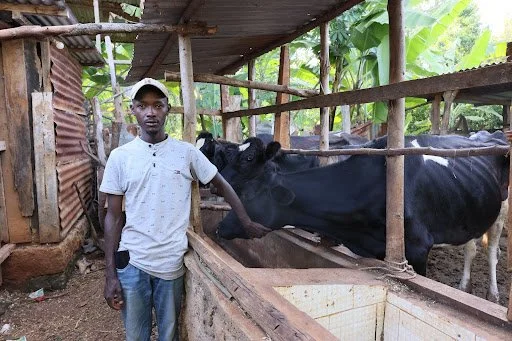
The Micro Enterprise Fellow and Peace Corps Volunteer interview Sebastian, a self-help group member.